
All posts by Brenda Villa

THE INVALIDITY DIVISION OF THE EUIPO HAS HELD TWO COMMUNITY DESIGNS TO BE INVALID FOR INFRINGEMENT OF ART. 4, PARA. 2, REG. 6/2002

22/11/2016

With two decisions dated 9 and 16 November, the Office held in favour of a claim of invalidity of two Community designs for movement devices of footboards and couch heads to be inserted within armchairs and couches.


Claims of invalidity were brought against designs for movement devices of footboards and couch heads to be inserted within armchairs and couches:
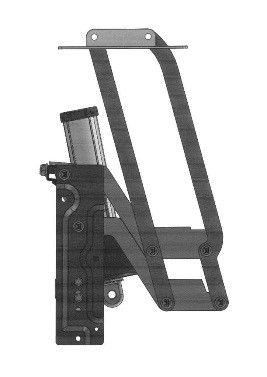
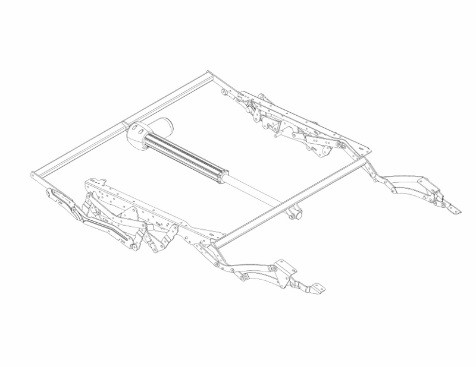
testiera                        pediera

The two actions for invalidity were put forward on the central basis of the non-protection of the above mentioned devices as designs for infringement, among other provisions, of arts. 4 and 8 of Reg. 6/2002. In the petitions it was argued that the devices could not benefit from the protection granted to designs because i) they were components of a complex product destined to become invisible during the normal use of the complex product in which they had been incorporated; ii) the characteristics of the appearance of the devices were determine solely by their technical function.

The decisions start from an analysis of art. 4 of Reg. 6/2002, observing that the component of a complex product is protectable if it possesses the requisites of novelty and individual character and remains visible once it is placed in its final position within the complex product. The Office, noting on the one side that the device has to be present from the beginning within the product and recalling, on the other side, that the concept of accessory requires the possibility of applying it to the finished product in a second moment, properly qualified the devices at issue as “components of a complex product”.

Once it had been established that the Community designs concerned the component of a complex product, the attention of the Division turned on the analysis of the requisite of visibility of the component during normal use. On this point, the decisions recalls the settled case law which provides that the requisites under art. 4 of the Regulation should be satisfied when the entire component may be seen, for a given period of time in such a way that its all essential characteristics may be recognized.

The Office therefore held for the declaration of invalidity considering the total invisibility of the component during normal use of the product. The other motives of invalidity were not examined for reasons of procedural economy.

The two decisions represent an important arrival point for the re-affirmation of the categories of industrial property rights and of the scopes of protection which have to be recognized to them – especially in the hypothesis of when the titles are released by the Office without prior control of the existence of the requisites of validity imposed by the Regulation.

In a system without preventive examination, it is easy to assist to episodes of manipulation of “false” industrial property rights which must be strongly contrasted for the purpose of restoring the proper market dynamics.
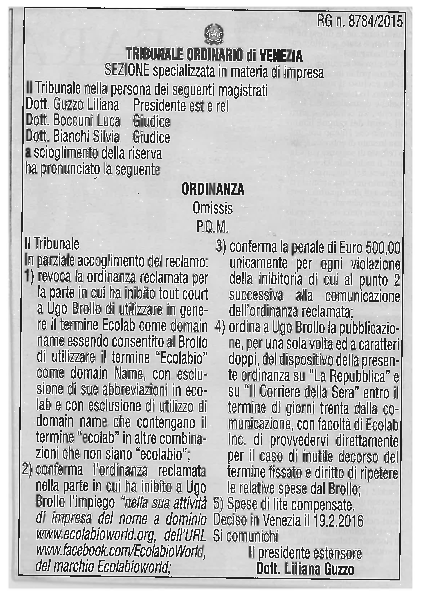

THE ITALIAN NEWSPAPER “IL CORRIERE DELLA SERA” HAS PUBLISHED THE RULING OF THE JUDGEMENT HELD BY THE COURT OF VENICE – COMMERCIAL DIVISION – THAT AFFIRMED THE RENOWN OF THE TRADEMARKS “ECOLAB”  AND DECLARED THE SIGN “ECOLABIOWORLD” AS INFRINGING WITH THEM.

15/11/2016

With the judgement published on May 12, 2016, the Court of Venice – Commercial division – ruled in favour of Ecolab Inc. and partially rejected the appeal against the decision of September 23, 2015, held by the same court in favour of the American multinational.


The appealed decision, taken at the end of an urgent proceedings promoted by Ecolab and aimed at the investigation of the infringement of its trademarks by the sign “Ecolabioworld”, had in fact inhibited the counterparty from using said sign within its business activity, the domain name www.ecolabioworld.org as well as in the Facebook page www.facebook.com/Ecolabioworld.

The board of appeal affirmed said decision, underlining that the trademark ECOLAB has acquired a high degree of renown and distinctiveness in the public of consumers. The second instance judges also reaffirmed that a high risk of confusion exists between the trademark ECOLAB and the sign “Ecolabioworld”, as in the comparison between two denominative signs the initial term (ECOLAB, in this case) significantly affects the memory of the consumer, while the remaining differences cannot be perceived as relevant. The addition of the words “io” and “world” to the challenged sign has been deemed conceptually unable to prevent a risk of confusion between the compared signs: it would be in fact inconceivable, the board of Venice affirms, that by seeing the sign “Ecolabioworld” the consumer is able to give a peculiar conceptual meaning to it, so as to distinguish it from the renowned trademark ECOLAB. Equally interesting is the part of the judgment where the Court of Venice has rejected the adverse request of acquiescence pursuant to Art. 28 of the Italian Code of Industrial Property, affirming that said principle does not apply to non-registered trademarks, as it necessarily requests the valid registration of the later sign whereof acquiescence is requested.

pubblicazione


INFRINGEMENT OF THE FAMOUS PRONGED “DIADORA” SIGN. THE COURT OF TURIN IS CALLED ON TO DEFINE THE LIABILITY OF THE INFRINGERS

08/11/2016

The Court of Turin, with decision dated August 3, 2016, held that the figurative mark representing the known bifurcated owned by Diadora S.r.l. had been infringed. The Turin Court found all the defendants liable for each having contributed – albeit in different ways – to the marketing of footwear bearing a sign mostly identical to the “Diadora” mark. The Court clarified that infringement may also include any contribution – even if only of an advertising nature – to the unlawful of a third party sign.


The petitioner Diadora S.r.l., a company which active within the footwear and clothing industry, proceeded to enforce its bifurcated mark  diadorawhich had already been registered at a national, international and European level.

In particular, the petitioner commenced urgent proceedings claiming that the defendant companies Melania Italia S.r.l., Fantasia Calzatura S.r.l. and Punto 4 S.r.l. had commercialized and advertised on several Internet certain footwear products, reproduced below, all of which had a “Melania” sign that was mostly identical to the mark registered by the

scarpe

The Court of Turin found that the sign fixed on the shoes advertised for sale by the defendants amounted to infringement of the signs of the petitioner, given that such sign entirely reproduced all the elements of the Diadora mark (including their dimension and positioning on the product) and the fact that the defendants had added a star on the upper prong of the sign was not enough to remove its evocative power of the Diadora mark and, therefore, the consequent risk of confusion as to the origin and provenance of the goods.

The Court of Turin held that all the defendants had been responsible for the infringement and thus rejected the exception raised by the defendant concerning the lack of passive legitimacy of the company Melania Italia S.r.l. which claimed that it had never entertained commercial relations neither with the petitioner nor with Fantasia Calzature and Punto 4 S.r.l. and was also not the owner of the domains www.melania.it and www.fantasiacalzature.it (which belonged to others) where the footwear with the star had been advertised. In particular, the Court reasoned that, according to settled case law, any causal contribution – albeit only of an advertising nature – to unlawful use of a third party sign may amount to an infringement.

In this case, it was known that Melania Italia S.r.l. had presented itself in the advertisements and on the market as the entity using the sign in dispute. Moreover, on the website www.melania.it – where the footwear had been advertised and sold – the indication “Melania Italia S.r.l.” was present and on the back of the box containing the shoes, purchased from the Pittarello shop in Turin, it was declared that the shoes were produced and distributed by Melania Group S.p.a.. Finally, an inquiry had revealed the existence of invoices issed by Melania Italia S.r.l. connected to the products bearing the disputed sign. Under those circumstances, the involvement of the defendant Melania with respect to the infringement of the sign had been ascertained.


THE COURT OF JUSTICE OF THE EUROPEAN UNION DECIDES ON THE ISSUE OF HYPERLINK AS „COMMUNICATION TO THE PUBLIC“

07/11/2016

With judgment of 8 September 2016, the Court of Justice of the European Union took into consideration the complex issue related to qualifying as “communication to the public” a hyperlink inserted within a web page. In particular, with judgment C-160/15 the Court declared that there is “communication to the public” when a link published on a website without the authorization of the copyright holder redirects the user to works that are protected and freely available on another website.


As for this case, in October 2011, GS Media – a company that manages the GeenStijl.nl website, one of the most visited Dutch current affairs webpages – inserted within the site a hyperlink redirecting users to an electronic file uploaded on the Australian data archive website Filefactory.com. That file was accessible by anyone who clicked on the link and contained photographs taken on commission by Sanoma, the editor of Playboy magazine, where said photographs were supposed to appear on the December 2011 edition of the magazine. In this way, the photographs were  made available to the public without authorization of the editor who holds the copyright in the photographs. On more than one occasion, Sanoma requested that GS Media remove the hyperlinks present on the GeenStijl website.

The issue considered by the Court of Justice had already been partly dealt with in 2014 by the Svensson judgment – to which reference was made in the  judgment here analysed – that provided the definition of “communication to the public”. In both judgments the Court stated that i) an act of “communication to the public” had occurred when, absent intervention by the user, the clients may not benefit from the divulgation of the work and ii) “public” should be understood as referring to an indefinite number of potential users, including a consistent number of people.

However, the GS Media case was decided in a different way from Svensson. In the latter case, the Court held that there was no “communication to the public” in so far as the hyperlink that had been made available to the users redirected them to a website on which content had been published with the authorization of the copyright holder. The hyperlink was not relevant for the divulgation of the content of the website to which the users were redirected, because the copyright holders over such work, when they had authorized its communication, had considered the entire group of Internet users as a public.

In the case considered here, however, the Court held that publication of a link amounts to “communication of the public”, on the grounds that i) the insertion of the link by the Dutch website had fulfilled the necessary condition for divulgation to the public which, in light of failure to act by GS Media, would not have benefited from the content and ii) the divulgation of the images was carried out without the authorization of the holder of the copyright in the photographs, and where GS Media, who acted in pursuit of financial gain, were aware of such lack of consent. Under those circumstances, the Court held that in this case communication of the link had caused the information to become accessible by a new and different public from that to which the photographs had been destined, with the consequence that such act could properly be qualified as a “communication to the public”.


PROTECTION OF PERSONAL DATA AND DYNAMIC IP ADDRESS

25/10/2016

The european judges qualified the dynamic IP address  as personal data where the provider of the Internet web page has the legal means to obtain from the Internet service provider the additional information necessary for complete identification of the user. 


The Court of Justice, with decision dated 19 October 2016, dealt with the issue of whether a dynamic internet protocol address (defined as an “IP address”) may be qualified as personal data and as such fall within the scope of the provisions under Directive 95/46/EC of the European Parliament and of the Council on the protection of individuals with regard to the processing of personal data and on the free movement of such data.

The case considered by the European judges originated from two preliminary matters referred by the German Federal Court of Justice (Bundesgerichtshof). The German Court had to deal with the petition filed by Mr. Patrick Breyer, a German citizen, against the appeal decision that had partially rejected his claims. The case arose following access by Mr. Breyer of various Internet sites traceable to the German federal services which, as a way to oppose IT piracy, register user access for each site and store it in a file register. The stored user data includes the name of the site and accessed file, the words inserted in the search bars, the date and time of access, the volume of transferred data, the message of outcome of the access and the IP address of the PC from which access was made.

Following access, Mr. Breyer filed a petition before the German administrative courts, requesting that the German Federal Republic be prevented from storing – also via third parties – the IP address of the Internet website user and in particular that of Mr. Breyer with regard to the ongoing proceedings. Following rejection of the petition at first instance, on appeal the judge held that the dynamic IP address constitutes personal data only if the user has revealed his identity during access of the website. According to the appellate judge, only in such case the operator of the Internet site may be in a position to identify the user by connecting his or her name with the IP address of his or her computer. The dispute reached the German Federal Court, which referred the matter to the Court of Justice of the European Union. The referred question was whether a dynamic IP address registered by the operator of an Internet web site, following access by the user, amounts to a personal data pursuant to Directive 95/46/EC, with respect to the operator, only if a third party, and in particular the Internet access supplier of the user, possesses the necessary information to identify the user.

The Court of Justice of the European Union, after acknowledging that it is settled that the static IP address allows unambiguous and permanent identification of the device connected to the network, also stated that the provider of the Internet web page would be able to identify the user accessing the page via the IP address only on the basis of further information generally supplied by a third party (i.e. the Internet access provider of the user). For these reasons, in order to qualify a dynamic IP address as personal data, and as such consider it subject to the above mentioned Directive, according to the European Court, it is necessary to verify whether the possibility of combining a dynamic IP address with the additional information kept by the Internet access provider amounts to a means that may reasonably be used by the provider of the Internet page for identifying the user. With regard to the case at hand, the Court of Justice of the European Union noted that German law does not allow the provider of the Internet page to obtain from the Internet access provider, upon mere request, additional information capable of identifying the user who utilizes a dynamic IP address. However, there are legal means that allow the provider of online media services facing cybernetic attacks to contact the competent authority, which may adopt the necessary measures in order to obtain the relevant information from the Internet access provider and thus commence criminal proceedings.

On those grounds, the Court of Justice of the European Union concluded that the dynamic IP address registered by the operator an Internet web page, following access by a user, only amounts to personal data if the operator has the legal means that allow it to identify the user via additional information possessed by the Internet access provider. It follows that the operator of the Internet page may collect and use personal data relating to a user of those services, without his or her consent, only in so far as the collection and use of that information are necessary to facilitate and charge for the specific use of those services by that user, even though the objective aiming to ensure the general operability of those services may justify the use of those data after consultation of those websites.