
THE INVALIDITY DIVISION OF THE EUIPO HAS HELD TWO COMMUNITY DESIGNS TO BE INVALID FOR INFRINGEMENT OF ART. 4, PARA. 2, REG. 6/2002

22/11/2016

With two decisions dated 9 and 16 November, the Office held in favour of a claim of invalidity of two Community designs for movement devices of footboards and couch heads to be inserted within armchairs and couches.


Claims of invalidity were brought against designs for movement devices of footboards and couch heads to be inserted within armchairs and couches:
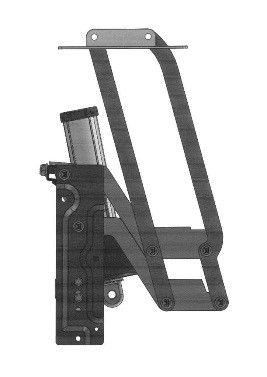
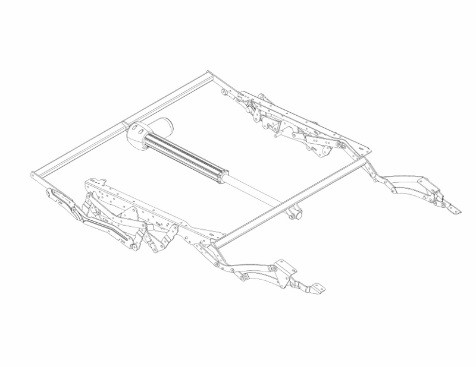
testiera                        pediera

The two actions for invalidity were put forward on the central basis of the non-protection of the above mentioned devices as designs for infringement, among other provisions, of arts. 4 and 8 of Reg. 6/2002. In the petitions it was argued that the devices could not benefit from the protection granted to designs because i) they were components of a complex product destined to become invisible during the normal use of the complex product in which they had been incorporated; ii) the characteristics of the appearance of the devices were determine solely by their technical function.

The decisions start from an analysis of art. 4 of Reg. 6/2002, observing that the component of a complex product is protectable if it possesses the requisites of novelty and individual character and remains visible once it is placed in its final position within the complex product. The Office, noting on the one side that the device has to be present from the beginning within the product and recalling, on the other side, that the concept of accessory requires the possibility of applying it to the finished product in a second moment, properly qualified the devices at issue as “components of a complex product”.

Once it had been established that the Community designs concerned the component of a complex product, the attention of the Division turned on the analysis of the requisite of visibility of the component during normal use. On this point, the decisions recalls the settled case law which provides that the requisites under art. 4 of the Regulation should be satisfied when the entire component may be seen, for a given period of time in such a way that its all essential characteristics may be recognized.

The Office therefore held for the declaration of invalidity considering the total invisibility of the component during normal use of the product. The other motives of invalidity were not examined for reasons of procedural economy.

The two decisions represent an important arrival point for the re-affirmation of the categories of industrial property rights and of the scopes of protection which have to be recognized to them – especially in the hypothesis of when the titles are released by the Office without prior control of the existence of the requisites of validity imposed by the Regulation.

In a system without preventive examination, it is easy to assist to episodes of manipulation of “false” industrial property rights which must be strongly contrasted for the purpose of restoring the proper market dynamics.
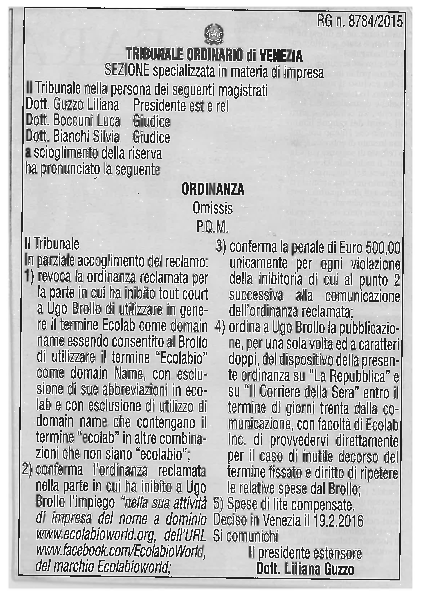

THE ITALIAN NEWSPAPER “IL CORRIERE DELLA SERA” HAS PUBLISHED THE RULING OF THE JUDGEMENT HELD BY THE COURT OF VENICE – COMMERCIAL DIVISION – THAT AFFIRMED THE RENOWN OF THE TRADEMARKS “ECOLAB”  AND DECLARED THE SIGN “ECOLABIOWORLD” AS INFRINGING WITH THEM.

15/11/2016

With the judgement published on May 12, 2016, the Court of Venice – Commercial division – ruled in favour of Ecolab Inc. and partially rejected the appeal against the decision of September 23, 2015, held by the same court in favour of the American multinational.


The appealed decision, taken at the end of an urgent proceedings promoted by Ecolab and aimed at the investigation of the infringement of its trademarks by the sign “Ecolabioworld”, had in fact inhibited the counterparty from using said sign within its business activity, the domain name www.ecolabioworld.org as well as in the Facebook page www.facebook.com/Ecolabioworld.

The board of appeal affirmed said decision, underlining that the trademark ECOLAB has acquired a high degree of renown and distinctiveness in the public of consumers. The second instance judges also reaffirmed that a high risk of confusion exists between the trademark ECOLAB and the sign “Ecolabioworld”, as in the comparison between two denominative signs the initial term (ECOLAB, in this case) significantly affects the memory of the consumer, while the remaining differences cannot be perceived as relevant. The addition of the words “io” and “world” to the challenged sign has been deemed conceptually unable to prevent a risk of confusion between the compared signs: it would be in fact inconceivable, the board of Venice affirms, that by seeing the sign “Ecolabioworld” the consumer is able to give a peculiar conceptual meaning to it, so as to distinguish it from the renowned trademark ECOLAB. Equally interesting is the part of the judgment where the Court of Venice has rejected the adverse request of acquiescence pursuant to Art. 28 of the Italian Code of Industrial Property, affirming that said principle does not apply to non-registered trademarks, as it necessarily requests the valid registration of the later sign whereof acquiescence is requested.

pubblicazione


PUBBLICATO SUL QUOTIDIANO “IL CORRIERE DELLA SERA” IL DISPOSITIVO DELL’ORDINANZA CON CUI IL TRIBUNALE DI VENEZIA, RIBADENDO LA NOTORIETA’ DEI MARCHI “ECOLAB”, HA GIUDICATO IL SEGNO “ECOLABIOWORLD” IN CONTRAFFAZIONE CON ESSI.

15/11/2016

Con ordinanza pubblicata il 12 maggio 2016, il Tribunale di Venezia – Sezione specializzata in materia di impresa – si è pronunciato a favore di Ecolab Inc., rigettando in parte il reclamo proposto avverso l’ordinanza del 23 settembre 2015 emessa dal medesimo Tribunale in favore della multinazionale statunitense.


L’ordinanza reclamata, resa all’esito di un giudizio cautelare promosso da Ecolab e diretto all’accertamento della contraffazione dei propri marchi da parte del segno “Ecolabioworld”, aveva infatti disposto l’inibitoria all’utilizzo di tale segno all’interno dell’attività di impresa della parte resistente, del nome a dominio www.ecolabioworld.org e della pagina Facebook www.facebook.com/Ecolabioworld. Il Giudice del reclamo ha confermato tale pronuncia sottolineando come il marchio ECOLAB abbia acquisito un elevato livello di notorietà e distintività nel pubblico dei consumatori. Il collegio veneziano ha altresì ribadito la sussistenza di un forte rischio di confusione tra il marchio azionato ECOLAB ed il segno “Ecolabioworld”, atteso che nel confronto tra due segni denominativi il lemma iniziale (ECOLAB, nella fattispecie) condiziona in modo significativo il ricordo del consumatore, essendo le restanti differenze non percepibili dal pubblico come rilevanti. L’aggiunta del lemma “io” e della parola “world” nel segno avverso è stata altresì ritenuta inidonea, sotto un profilo concettuale, a scongiurare il rischio di confusione tra i segni a confronto: sarebbe infatti impensabile, affermano i giudici veneziani, che vedendo il segno “Ecolabioworld” il pubblico di riferimento sia in grado di attribuire allo stesso una peculiare valenza concettuale, tale da distinguerlo dal noto marchio ECOLAB. Interessante, infine, il passaggio dell’ordinanza in cui il Tribunale di Venezia, rigettando l’avversaria domanda di convalidazione del segno “ecolabioworld” ai sensi dell’art. 28 c.p.i., ha ribadito che tale istituto non si applica ai marchi di fatto, presupponendo la valida registrazione del segno posteriore di cui si chiede la convalida.

pubblicazione


CONTRAFFAZIONE DEL NOTO SEGNO BIFORCATO “DIADORA”. IL TRIBUNALE DI TORINO CHIAMATO A DEFINIRE I SINGOLI PROFILI DI RESPONSABILITA’ DEGLI “ATTORI” DELLA VIOLAZIONE.

08/11/2016

Il tribunale di Torino, con ordinanza pubblicata in data 3 agosto 2016, ha accolto la domanda di accertamento della contraffazione svolta dalla società Diadora s.r.l., titolare di diverse registrazioni aventi ad oggetto il marchio figurativo costituito dal noto segno biforcato . I Giudici Torinesi hanno ritenuto responsabili della condotta contraffattiva tutte le resistenti per aver contribuito – seppur in maniera diversa – alla commercializzazione della calzature recanti un segno pressoché uguale a quello “Diadora”. Il Tribunale ha chiarito infatti che costituisce contraffazione qualsiasi contributo – anche solo pubblicitario – all’utilizzo illecito del segno altrui.


A fondamento delle proprie domande la società ricorrente Diadora s.r.l., che opera da molti anni nel settore delle calzature e dell’abbigliamento, azionava il marchio figurativo costituito dal segno biforcato oggetto di risalenti registrazioni nazionali, internazionali e comunitarie, di seguito riprodotto   diadora.

In particolare, la ricorrente introduceva il procedimento cautelare documentando che le resistenti Melania Italia s.r.l., Fantasia Calzature e Punto 4 s.r.l. commercializzavano e pubblicizzavano per la vendita sui siti internet, le seguenti calzature a marchio “Melania”, recanti un segno pressocchè uguale al proprio marchio registrato:

scarpe

Il Tribunale di Torino rilevava che il segno apposto dalle resistenti sulle scarpe pubblicizzate per la vendita costituiva contraffazione dei segni della ricorrente, atteso che riproduce interamente tutti gli elementi del marchio Diadora (dimensione e posizionamento sul prodotto comprese) e che l’accorgimento di apporre una stella sulla biforcazione superiore del segno non era sufficiente ad eliminare la capacità evocativa del marchio Diadora e il conseguente rischio di confusione sull’origine e provenienza dei prodotti.

I Giudici Torinesi ritenevano dunque tutte le resistenti responsabili di tale atto contraffattivo, rigettando in tal senso l’eccezione di legittimazione passiva formulata dalla società Melania Italia s.r.l. la quale sosteneva di non intrattenere rapporti commerciali né con la ricorrente né con Fantasia Calzature e Punto 4 s.r.l. e di non essere titolare dei domini www.melania.it e www.fantasiacalzature.it (appartenenti ad altri soggetti) sui quali sono state pubblicizzate le calzature contenenti il fregio con la stella. In particolare, i Giudici Torinesi motivavano il rigetto di tale eccezione preliminare sostenendo che, secondo consolidato giurisprudenziale, costituisce contraffazione qualsiasi contributo causale – anche solo pubblicitario – all’utilizzo illecito del segno altrui.

Nel caso di specie, è documentato che è la stessa ricorrente Melania Italia s.r.l. nella pubblicità e nel commercio a presentarsi come il soggetto che usa il segno oggetto del procedimento. Inoltre, sul sito www.melania.it – dove vengono pubblicizzate e commercializzate le scarpe oggetto di contestazione – compare l’indicazione “Melania Italia srl” e dal retro della scatola di cartone contenente le scarpe acquistate nel negozio Pittarello di Torino viene dichiarato che le stesse sono prodotte e distribuite da Melania Group s.p.a.. Infine, nel corso dell’esecuzione sono emerse fatture emesse da Melania Italia s.r.l. nei confronti di soggetti aventi sede in Paesi europei relative a prodotti contrassegnati con il fregio in contestazione. Da tali elementi emergeva dunque con evidenza il pieno coinvolgimento della resistente Melania nella dedotta contraffazione del segno della ricorrente.


INFRINGEMENT OF THE FAMOUS PRONGED “DIADORA” SIGN. THE COURT OF TURIN IS CALLED ON TO DEFINE THE LIABILITY OF THE INFRINGERS

08/11/2016

The Court of Turin, with decision dated August 3, 2016, held that the figurative mark representing the known bifurcated owned by Diadora S.r.l. had been infringed. The Turin Court found all the defendants liable for each having contributed – albeit in different ways – to the marketing of footwear bearing a sign mostly identical to the “Diadora” mark. The Court clarified that infringement may also include any contribution – even if only of an advertising nature – to the unlawful of a third party sign.


The petitioner Diadora S.r.l., a company which active within the footwear and clothing industry, proceeded to enforce its bifurcated mark  diadorawhich had already been registered at a national, international and European level.

In particular, the petitioner commenced urgent proceedings claiming that the defendant companies Melania Italia S.r.l., Fantasia Calzatura S.r.l. and Punto 4 S.r.l. had commercialized and advertised on several Internet certain footwear products, reproduced below, all of which had a “Melania” sign that was mostly identical to the mark registered by the

scarpe

The Court of Turin found that the sign fixed on the shoes advertised for sale by the defendants amounted to infringement of the signs of the petitioner, given that such sign entirely reproduced all the elements of the Diadora mark (including their dimension and positioning on the product) and the fact that the defendants had added a star on the upper prong of the sign was not enough to remove its evocative power of the Diadora mark and, therefore, the consequent risk of confusion as to the origin and provenance of the goods.

The Court of Turin held that all the defendants had been responsible for the infringement and thus rejected the exception raised by the defendant concerning the lack of passive legitimacy of the company Melania Italia S.r.l. which claimed that it had never entertained commercial relations neither with the petitioner nor with Fantasia Calzature and Punto 4 S.r.l. and was also not the owner of the domains www.melania.it and www.fantasiacalzature.it (which belonged to others) where the footwear with the star had been advertised. In particular, the Court reasoned that, according to settled case law, any causal contribution – albeit only of an advertising nature – to unlawful use of a third party sign may amount to an infringement.

In this case, it was known that Melania Italia S.r.l. had presented itself in the advertisements and on the market as the entity using the sign in dispute. Moreover, on the website www.melania.it – where the footwear had been advertised and sold – the indication “Melania Italia S.r.l.” was present and on the back of the box containing the shoes, purchased from the Pittarello shop in Turin, it was declared that the shoes were produced and distributed by Melania Group S.p.a.. Finally, an inquiry had revealed the existence of invoices issed by Melania Italia S.r.l. connected to the products bearing the disputed sign. Under those circumstances, the involvement of the defendant Melania with respect to the infringement of the sign had been ascertained.